
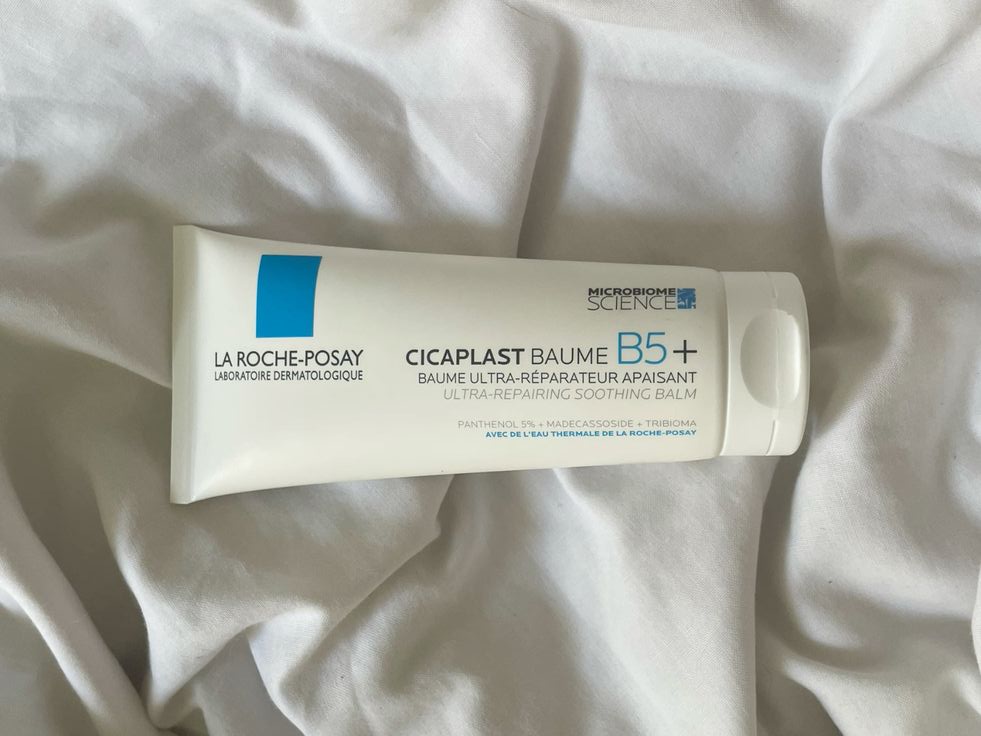
If your skin suddenly burns, stings, or reacts to every product in your cabinet, your skin barrier might be damaged. La Roche-Posay Cicaplast Baume B5+ is frequently recommended as the ultimate “rescue cream,” but many wonder: is Cicaplast good for acne, and does Cicaplast clog pores?
- Why Your Skin Burns and Reacts: Understanding Barrier Damage
- How Cicaplast B5+ Actually Repairs Your Skin
- Can Cicaplast Clog Pores? The Truth for Acne-Prone Skin
- How to Use Cicaplast WITHOUT Clogging Pores
- Final Verdict
This post contains affiliate links, meaning I may earn a commission if you click through and make a purchase, at no additional cost to you.
1. Why Your Skin Burns and Reacts: Understanding Barrier Damage
A compromised barrier is a common side effect for those using high-strength retinol, acids, or aggressive cleansers. Effectively, your skin’s “protective shield” has been breached.
The Two Roles of a Healthy Skin Barrier
Protection: It blocks external factors like dirt and UV radiation. Interestingly, healthy skin is naturally resistant to letting active ingredients penetrate too deeply.
Hydration: It prevents water from escaping, keeping moisture locked in.
What happens when the barrier is damaged?
When your hydrolipid barrier (HLB) is compromised, two key things happen:

In short, your skin stops defending itself. This leads to skin barrier damage symptoms like stinging upon application, sudden sensitivity, and a feeling of tightness even after moisturizing.
2. How Cicaplast B5+ Actually Repairs Your Skin
La Roche-Posay Cicaplast Baume works primarily as a soothing and regenerating cream that supports the restoration of the skin’s hydrolipid barrier — but it does so on multiple levels at once.

This is not just a “regular moisturizer.”
It’s an SOS skincare product designed for compromised, irritated skin.
Cicaplast Baume B5 Key Ingredients & Their Roles

The role of formula
While silicones are sometimes debated, they serve a vital purpose here. They provide a biologically inert base that doesn’t react with the skin or penetrate deeply, making it safe for ultra-sensitive types.
The Fact: The strong occlusive effect of the Baume supports the penetration of its active ingredients—Panthenol and Madecassoside work even better because of it.

In practice, after application,
- the skin loses less water (↓ TEWL),
- stinging decreases,
- the barrier has the perfect healing microenvironment for where the skin can repair itself undisturbed.
This microenvironment is the key — our skin is capable of regenerating itself, and this cream simply ensures that nothing interferes with that process. It’s a really well-designed formula.
Remember not to use this product all the time, so as not to ‘make your hydrolipid barrier lazy.’ We use it to support the skin barrier, but ultimately, the healthy barrier should be able to manage on its own.
3. Can Cicaplast Clog Pores? The Truth for Acne-Prone Skin
The answer isn’t a simple “yes” or “no.” While the product is not non-comedogenic in the traditional sense, its heavy, occlusive formula can contribute to imperfections if used incorrectly.
| Product Feature | What It Means for Your Skin |
| Rich, heavy formula | May be too occlusive for oily skin. |
| Occlusive action | Creates a layer that limits skin “breathing”. |
| Full-face application | Can be “too much” for certain skin types. |
The “Morning After” Mistake
A major reason for clogged pores is improper cleansing. If you apply Cicaplast at night, the occlusive layer often remains in the morning. If you only wash your face with water in the morning, you may not fully remove the residue. Applying serum, cream, and SPF over this leftover film traps everything underneath, potentially leading to blackheads, small bumps, or worsened acne.

4. How to Use Cicaplast WITHOUT Clogging Pores
To get the benefits without the breakouts, follow these application rules:
Avoid Constant Use: Do not use it as a daily moisturizer forever. Over-reliance can make the skin barrier “lazy,” as it stops performing its own protective functions. Use it periodically when the skin is irritated or dry.
The “Less is More” Rule: Apply a very thin layer. A thicker layer won’t speed up healing but will increase the risk of clogging.
Clean Skin is Mandatory: Never apply it over sebum, SPF, or makeup residue, as this “locks in” impurities under the occlusion.
Best Ways to Apply:
- Regenerating Mask: Apply a thicker layer for 30-60 minutes, then gently wash it off. This provides intense repair without overnight occlusion.
- Spot Treatment: Use it only on dry patches, around the nose, or specifically where you have irritation from active ingredients.
- SOS After Actives: A thin layer helps calm the skin after using high concentrations of retinol or acids.
- Weather Shield: It acts as a “shield” against frost, wind, and harsh conditions.
5. Final Verdict

YES, IT’S WORTH THE HYPE.
If your skin barrier is damaged, La Roche-Posay Cicaplast Baume B5+ can be a genuine lifesaver. However, if you have acne-prone skin, how you apply it is more important than the product itself.
Use it consciously, cleanse properly, and it will remain a powerful tool in your skincare kit rather than a cause of breakouts.
Leave a Reply