
Why Should You Read This Article?
If you have ever wondered why your skin reacts the way it does to retinoids, this article provides clear, science-based answers. By the time you finish reading, you will know everything there is to know about these powerful ingredients. We break down exactly how retinoids function within the skin so you can understand irritation, “purging,” and actual results rather than just guessing.
You will also learn how to choose the right form for your specific skin type, avoid common mistakes, and maximize benefits while minimizing side effects.
- What Exactly Are Retinoids?
- Types of Retinoids: Potency and Strength
- The Biochemical Mechanism: How They Work
- Effects on Skin – What Actually Changes
- Why Retinoids Can Cause Irritation
- The Retinization Process (The Adaptation Phase)
- Common Myths Debunked
- How to Use Retinoids: Science-Based Strategies
- Tips for Extremely Sensitive Skin
- The “Sandwich” Method:
- Short Contact Therapy:
- Tips for Extremely Sensitive Skin
- Who Should Avoid Retinoids?
- SUMMARY: Quick Guide to Using Retinoids Safely and Effectively
1. What Exactly Are Retinoids?
Definition: Retinoids are derivatives of Vitamin A that interact with RAR and RXR receptors within the cell nucleus of skin cells.
Retinoids are classified by “generations.” First-generation retinoids (such as retinol and retinal) are the only forms that are not classified as drugs and can be found in their pure form in over-the-counter cosmetics.
The Conversion Process
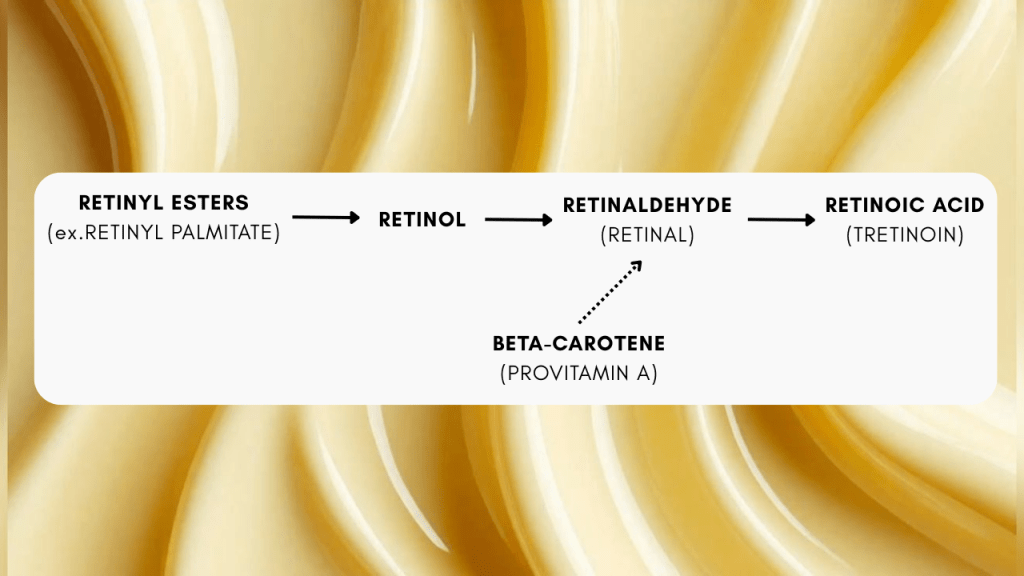
The conversion of retinoids in the skin is a stepwise metabolic process. Less active forms must be converted into their biologically active state to work. Retinoic acid is the key active molecule that ultimately binds to the nuclear RAR and RXR receptors.
Fact: Retinal is the result of beta-carotene conversion (which is itself a pro-vitamin A). This is why eating carrots is often called “eating your retinol“.
2. Types of Retinoids: Potency and Strength
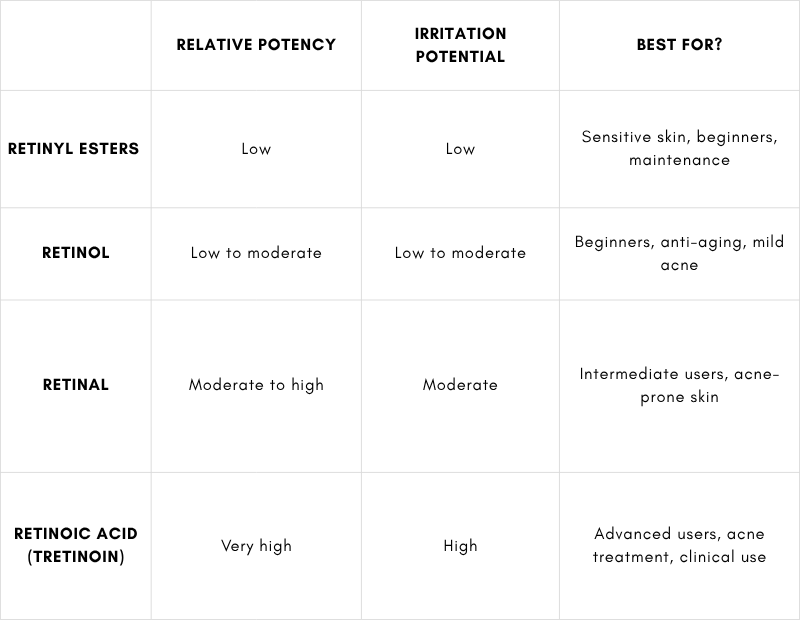
Because the conversion path to retinoic acid varies in length, different forms require different concentrations to be effective:
- Retinol: Concentrations in cosmetics typically start between 0.1% and 0.3%.
- Retinal: Highly potent and effective even at concentrations as low as 0.03%.
3. The Biochemical Mechanism: How They Work
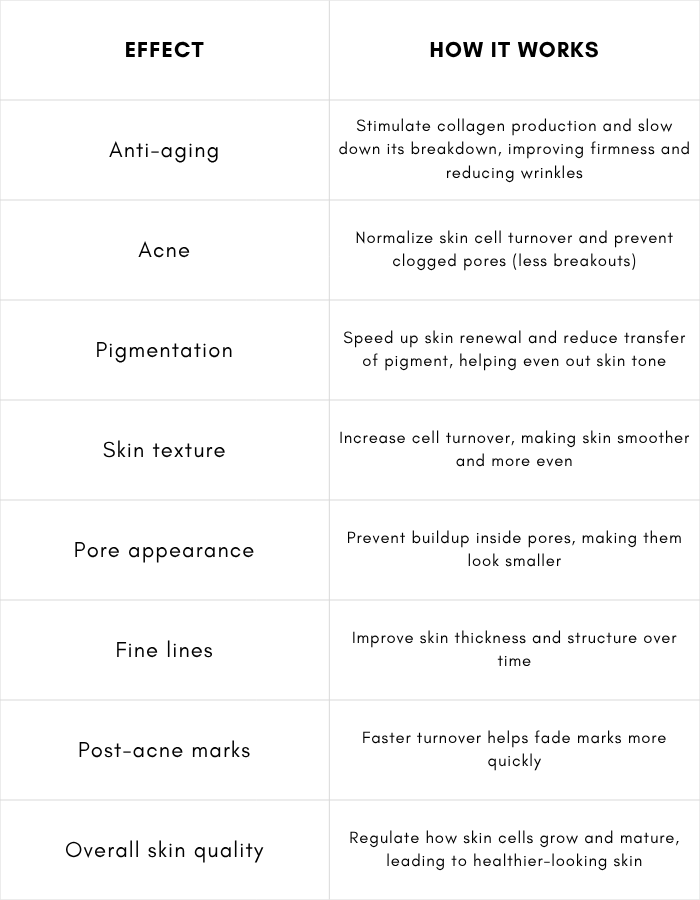
As established, retinoids function by interacting with the RAR and RXR receptors in the skin cell’s nucleus (both in the epidermis and dermis). This interaction triggers several key biological responses:

- Gene Expression: Stimulates the synthesis of collagen and elastin, providing powerful anti-aging effects.
- Cellular Turnover: Increases the proliferation of keratinocytes and normalizes the keratinization process.
- Skin Refinement: Leads to faster skin renewal and visible smoothing of the skin texture.
Fact: Beyond its conversion to retinoic acid, retinal (as a standalone substance) also possesses unique antibacterial properties.
4. Effects on Skin – What Actually Changes
5. Why Retinoids Can Cause Irritation
The same rapid cellular turnover that gives us great results also carries risks. Retinoids can shorten the skin’s renewal cycle from the standard 28 days down to just 14–16 days. This means immature cells reach the surface faster.
Consequently, these new layers of the epidermis are delicate and highly susceptible to:
- Irritation and external factors.
- UV radiation.
- A temporary decline in barrier function.
- Increased TEWL (Transepidermal Water Loss) and micro-inflammation.
Visually, this often manifests as dryness, redness, peeling, or general sensitivity.
6. The Retinization Process (The Adaptation Phase)
Retinization is the period during which your skin adapts to retinoids. It is a controlled state of irritation and remodeling. It is important to remember that this is not a “side effect” in the traditional sense, but rather a physiological response to a strong biological signal.

How long does it last?
The duration depends on the concentration used, the specific form (retinol vs. retinal vs. tretinoin), and your individual skin type. On average:
- 2–6 weeks: The acute phase.
- 8–12 weeks: Full adaptation.
What happens after adaptation?
Once the “magic of retinol” kicks in, you will notice:
- The skin barrier rebuilds and strengthens.
- Skin becomes less reactive and tolerance increases.
- Dominant results appear: smoothing, acne healing, a healthy glow, and wrinkle reduction.
Innovation Note: New technologies, such as encapsulated retinoids, are increasingly available to help reduce the side effects of the retinization process.
7. Common Myths Debunked
“You can’t use retinoids in the summer”
False. You can use them year-round, provided you are diligent with high-level sun protection. Without SPF, however, you may do more harm than good.
“Higher percentages are always better”
False. Every skin type is different, and every concentration of retinoid works—the only difference is the speed of results. While higher concentrations work faster, they carry a much higher risk of side effects.
Warning: Chronic micro-inflammation caused by excessive irritation can actually accelerate skin aging by producing Reactive Oxygen Species (ROS). To achieve healthy, balanced skin, treat retinoids like a marathon, not a sprint.
8. How to Use Retinoids: Science-Based Strategies
When it comes to receptor activation, “more frequent” does not equal “better”. The RAR/RXR receptors do not respond linearly.
If you apply retinoids too often (e.g., every day from the start):
You do not proportionally increase the biological effect.
You do accumulate irritation, damage the skin barrier, and increase inflammation.
The Optimal Strategy
Activate the receptors regularly but allow time for adaptation.
- Start: 2–3 times per week.
- Progression: Increase frequency by only one day per week, roughly once a month.
- Why? Results come from consistent gene activation over time, not from “flooding” the skin with product.
Tips for Extremely Sensitive Skin
If your skin remains irritated even with low concentrations 2–3 times a week, try retinyl esters or these methods:
The “Sandwich” Method:
Apply a
light Moisturizer – > Retinoid – > Moisturizer.
This creates a buffer that limits irritation.
Short Contact Therapy:
Apply the retinoid product for 2–3 hours, then wash it off.
Shorter contact time means less irritation.
These methods may slow down the timeline for results, but they make the transition phase manageable until your skin can tolerate normal leave-on use.
9. Who Should Avoid Retinoids?
While retinoids are gold-standard ingredients, they aren’t for everyone. Avoid them if you are:
- Pregnant or breastfeeding.
- Dealing with hypersensitive skin or specific dermatological conditions (consult a doctor first).
If you have followed all the best practices—using low concentrations of quality products over a long period—and your skin still hasn’t improved, you may simply be part of the group whose skin does not tolerate retinoids. AND THAT’S OK! Modern skincare offers many other advanced active ingredients that can provide similar results.
10. SUMMARY: Quick Guide to Using Retinoids Safely and Effectively
- Biological Benefits: By influencing gene expression, retinoids increase collagen and elastin synthesis, speed up cell renewal, and normalize the skin’s texture. This results in visible anti-aging effects, a healthy glow, and smoother skin.
- Understanding the “Purge”: Retinoids shorten your skin’s renewal cycle. This rapid turnover can temporarily weaken your skin barrier, leading to dryness, peeling, or redness.
- The Retinization Phase: Your skin needs 2 to 12 weeks to fully adapt to a new retinoid. This is a physiological response, not a standard side effect.
- Smart Application: More is not better; frequency does not equal faster results. Start 2–3 times per week to avoid overloading receptors and causing unnecessary inflammation.
- Protection is Mandatory: You can use retinoids year-round, but you must use high SPF daily. Because new skin layers are delicate, unprotected UV exposure can cause more harm than good.
- Who Should Skip: Retinoids should be avoided by pregnant or breastfeeding women and those with extremely reactive or diseased skin conditions without medical consultation.
 Skin Science Guide
Leave a comment